


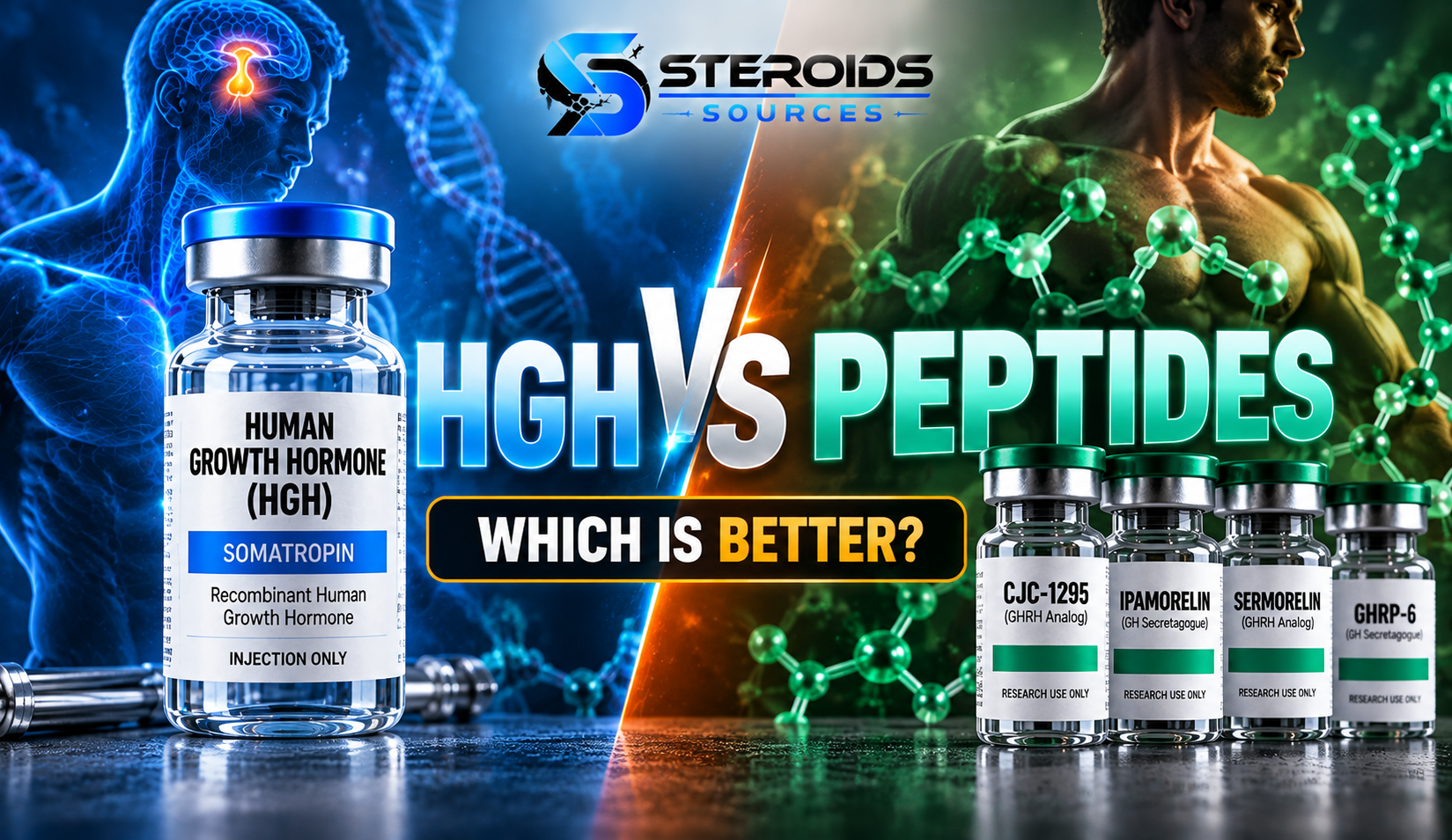
HGH Vs PEPTIDES


HGH or Peptides: What’s the Difference?
HGH vs peptides is an important comparison for anyone researching human growth hormone, growth hormone-releasing peptides, muscle growth, recovery, and body composition. Although HGH is itself a peptide hormone, other peptides can act through different biological pathways, and their benefits, evidence, and safety profiles are not interchangeable.
The biggest distinction is simple:
HGH is itself a peptide hormone.
Human growth hormone, or HGH, is a protein hormone made naturally by the pituitary gland. Recombinant HGH, such as somatropin, is a manufactured version of human growth hormone used medically for specific growth hormone deficiencies and other approved conditions.
The word “peptides,” however, describes a much broader category. Some peptides can influence growth hormone release, while others have completely different biological targets.
That means asking whether HGH or peptides is “better” isn’t really an apples-to-apples comparison.
Is HGH a Steroid or a Peptide?
HGH is a peptide hormone, not an anabolic steroid.
This distinction is important because HGH and anabolic-androgenic steroids work through very different biological pathways.
HGH is a protein made from amino acids and acts primarily through growth-hormone receptors and downstream pathways involving insulin-like growth factor 1 (IGF-1).
Anabolic steroids, by contrast, are steroid hormones related structurally to testosterone and act primarily through androgen receptors.
So if you’re wondering:
Is HGH a peptide or steroid?
The answer is peptide hormone.
HGH should not be classified as an anabolic steroid simply because athletes and bodybuilders sometimes discuss the two together.
What Is HGH?
Human growth hormone is produced naturally by the anterior pituitary gland.
It plays important roles in childhood growth and continues to have physiological functions throughout adulthood, including effects on body composition, bone and tissue metabolism, and other aspects of metabolism.
The medical version is generally referred to as recombinant human growth hormone or somatropin.
There are also longer-acting growth hormone medicines. For example, the FDA approved somapacitan for adults with growth hormone deficiency, providing a once-weekly treatment option.
Importantly, prescription HGH is a medical treatment. That doesn’t mean it is appropriate for someone who simply wants to improve physique, athletic performance, or appearance.
What Are Growth Hormone Peptides?
“Growth hormone peptides” can refer to several different groups of compounds.
Some peptides are designed to influence the body’s own growth hormone secretion rather than directly providing growth hormone.
Two important categories are:
GHRH-related compounds
These act on pathways associated with growth hormone-releasing hormone.
Growth hormone secretagogues
These stimulate growth hormone release through other mechanisms, including compounds that interact with the ghrelin/growth hormone secretagogue receptor.
Examples discussed in pharmacology include compounds such as sermorelin, CJC-1295, GHRP-2, GHRP-6 and ipamorelin.
The important point is that these compounds aren’t simply “HGH in peptide form.” They interact with the body’s growth hormone regulatory system in different ways.
HGH vs Peptides at a Glance

HGH or Peptides: Which Is Better?
HGH Vs PEPTIDES: isn’t one universal answer.
For someone with medically diagnosed growth hormone deficiency, an approved growth hormone product may be an appropriate medical treatment because it directly replaces growth hormone under medical supervision.
For experimental growth-hormone secretagogues, the situation is different.
Some compounds have been investigated for their ability to increase growth hormone secretion, but increased GH or IGF-1 does not automatically mean a person will experience the same clinical benefits as someone receiving medically indicated GH replacement.
This distinction matters particularly in bodybuilding and anti-aging discussions.
A compound can change a laboratory marker without producing a meaningful improvement in long-term health, muscle development, athletic performance, or quality of life.
HGH vs Peptides for Muscle Growth
This is where online marketing often gets ahead of the evidence.
HGH has legitimate physiological effects on growth and metabolism, but that doesn’t mean more HGH automatically translates into proportionally more muscle.
Likewise, a peptide that increases growth hormone secretion isn’t automatically a proven muscle-building drug.
Growth hormone affects multiple tissues and metabolic pathways. Its effects are not equivalent to those produced by anabolic-androgenic steroids.
For someone interested in bodybuilding, it’s therefore important to separate:
- increasing GH levels
- increasing IGF-1
- reducing body fat
- increasing lean body mass
- increasing muscle strength
- improving athletic performance
These are different outcomes.
HGH or Peptides for Fat Loss
HGH Vs PEPTIDES: Growth hormone has effects on fat metabolism, which is one reason HGH frequently appears in bodybuilding and physique discussions.
However, that doesn’t mean HGH should be considered a general-purpose fat-loss treatment.
The FDA-approved uses of HGH are based on specific medical indications, not simply the desire to lose body fat or improve physique.
The same caution applies to growth hormone secretagogues.
Increasing GH secretion is not synonymous with demonstrating meaningful, long-term fat loss in healthy people.
Are Peptides Safer Than HGH?
This is another question where a simple yes-or-no answer can be misleading.
“Peptide” describes a chemical class, not a safety category.
Some peptide-based medicines are well studied and approved for specific medical conditions.
Other peptides remain investigational.
Others are sold online as research chemicals with limited human safety data.
Therefore, saying that something is “just a peptide” doesn’t tell you whether it is safe.
The specific compound, manufacturing quality, dose, route of administration, medical indication, and quality of clinical evidence all matter.
What Are the Risks of HGH?

Prescription growth hormone has recognized adverse effects and contraindications.
Depending on the patient and treatment, concerns can include fluid retention, joint or muscle discomfort, glucose intolerance, hypertension, and increased intracranial pressure.
The FDA notes that growth hormone products can cause or worsen intracranial hypertension and require appropriate monitoring. Certain conditions, including active malignancy and specific diabetic eye disease, are contraindications for some products.
This is one reason legitimate HGH treatment involves medical assessment rather than simply purchasing a product online.
What Are the Risks of Growth Hormone Peptides?
The risks depend heavily on the specific peptide.
A medically studied peptide and an experimental research chemical should not be discussed as though they have the same safety profile.
Potential concerns can include:
- unexpected hormonal effects
- changes in glucose regulation
- fluid retention
- headaches
- injection-site reactions
- contamination or incorrect concentration in poorly manufactured products
- unknown long-term effects for inadequately studied compounds
There is also an important quality-control issue with products sold through unregulated channels.
A label saying “research use only” does not establish that the contents are accurately represented, sterile, or safe for human injection.
HGH and Peptides for Bodybuilding
HGH and growth hormone-related peptides have become popular subjects in bodybuilding communities.
But popularity isn’t the same thing as evidence.
Some athletes use the compounds because of their potential effects on body composition, recovery, or growth-hormone signaling. However, those uses are different from approved medical indications.
It’s also important not to confuse HGH with anabolic steroids.
HGH doesn’t activate the androgen receptor in the same way that testosterone and other anabolic-androgenic steroids do.
This is why HGH and anabolic steroids shouldn’t be treated as interchangeable drugs.
Is HGH Better Than CJC-1295 or Ipamorelin?
This is a more specific version of the same question, and it still depends on what you’re trying to accomplish.
CJC-1295 and ipamorelin are commonly discussed as growth-hormone-related peptides, but they don’t simply equal pharmaceutical HGH.
They work through different mechanisms intended to influence endogenous GH secretion.
That difference can affect the resulting hormonal pattern and makes it inappropriate to assume that increasing GH secretion produces identical effects to administering GH itself.
More importantly, the evidence base and regulatory status differ between these compounds and approved HGH products.
HGH vs Peptides: Why the Terminology Matters
One of the biggest problems in the online peptide market is that the word “peptide” can make very different substances sound equivalent.
Consider the difference between:
Approved peptide medication
A drug that has undergone regulatory review for particular uses.
Investigational peptide
A compound being studied but lacking established approval for the claimed use.
Research chemical
A substance sold for laboratory research rather than established human treatment.
Growth hormone secretagogue
A compound that stimulates the body’s GH secretion.
HGH
The actual growth hormone molecule, used medically in approved formulations.
Those categories shouldn’t be mixed together.
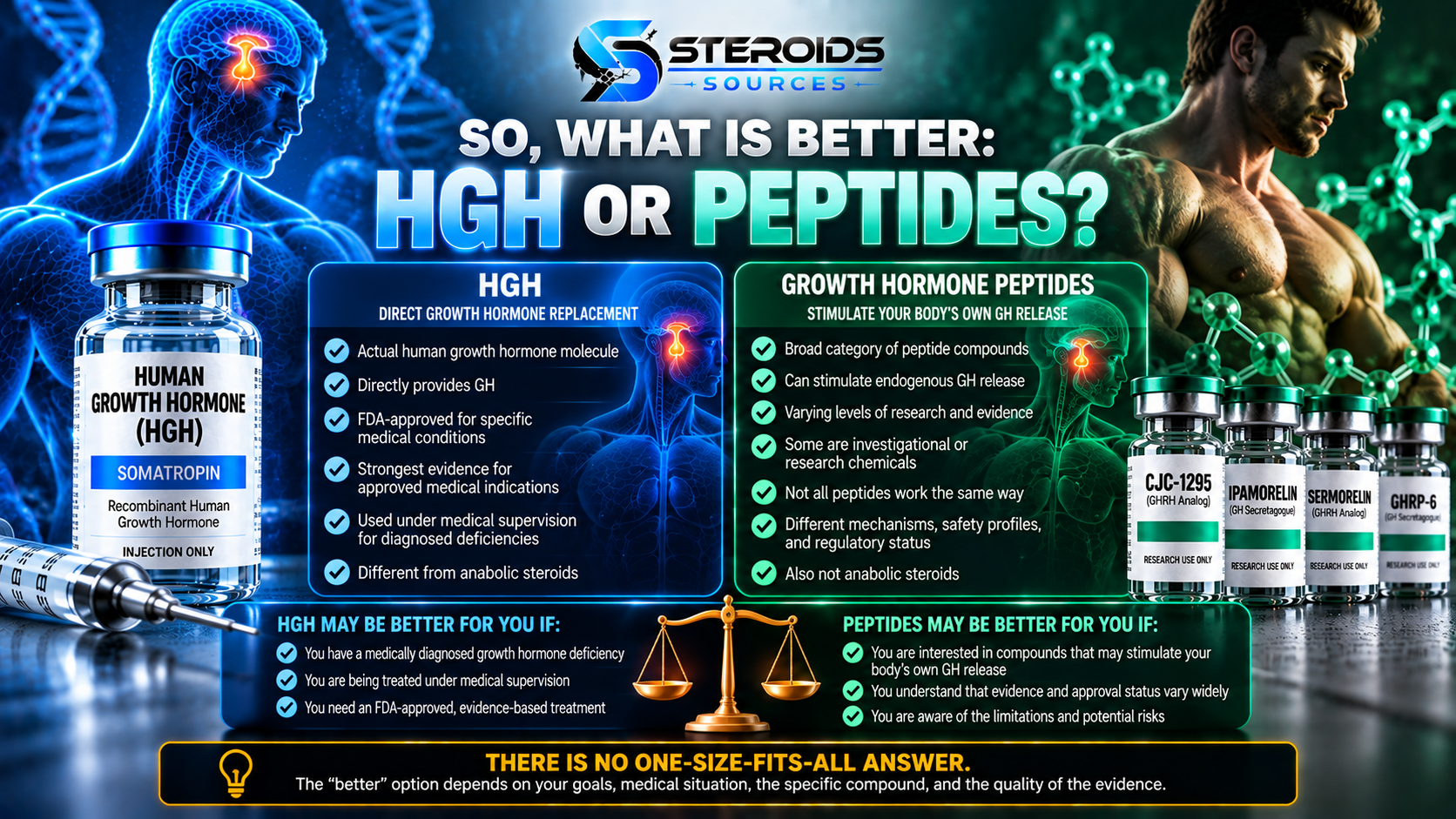
So, What Is Better: HGH or Peptides?
For medical treatment of confirmed growth hormone deficiency, the relevant question isn’t which compound is more popular online.
The question is which evidence-based treatment is appropriate for the individual’s diagnosis.
Approved HGH products have established medical indications and regulatory oversight.
Growth hormone peptides are a much broader category. Some have legitimate medical research behind them, while others remain experimental or have limited evidence.
So there is no scientifically sound answer that says “peptides are better than HGH” or “HGH is always better than peptides.”
The right comparison depends on the specific compound, medical indication, evidence, and patient.
The Bottom Line
HGH is a peptide hormone, not an anabolic steroid.
The word “peptides” covers a much larger group of compounds, including some that can influence growth hormone secretion.
For medically diagnosed growth hormone deficiency, approved HGH therapies have a well-established role. The FDA has approved several growth hormone products for specific pediatric and adult indications, including adult growth hormone deficiency.
Outside those indications, the situation becomes much less straightforward.
Growth hormone secretagogues and other peptides are often marketed for muscle growth, fat loss, recovery, or anti-aging, but evidence varies substantially from one compound to another.
The most important takeaway is simple: don’t use the word “peptide” as a shortcut for “safe,” and don’t assume that increasing growth hormone is equivalent to medically replacing growth hormone.
FAQ
Is HGH a peptide or steroid?
HGH is a peptide hormone. It is not an anabolic steroid.
Is HGH a peptide or a steroid?
HGH is a peptide hormone made from amino acids. Steroids are structurally different lipid-derived hormones.
What is better, HGH or peptides?
There isn’t a universal answer. HGH and growth hormone-related peptides have different mechanisms, evidence, and regulatory status.
Can peptides increase HGH?
Some growth hormone secretagogues can stimulate the body’s secretion of growth hormone. The effect depends on the specific compound.
Is HGH the same as CJC-1295?
No. HGH is the growth hormone molecule itself, while CJC-1295 is a synthetic peptide designed to influence growth hormone-releasing hormone pathways.
Is HGH a steroid for bodybuilding?
HGH Vs PEPTIDES: No. HGH is a peptide hormone. It is sometimes used alongside anabolic steroids in bodybuilding, but the two substances belong to different drug classes.
Are all peptides approved medications?
No. Some peptides are approved medicines, while others are investigational or marketed as research chemicals.