


BPC 157 vs TB 500

BPC 157 vs TB 500: Which Peptide Has Better Research Evidence?
The comparison bpc 157 vs tb 500 is popular among bodybuilders, athletes, armwrestlers, and people researching experimental compounds for injury recovery. Both peptides are frequently discussed in connection with tendon injuries, muscle recovery, connective tissue, and rehabilitation. Online sellers and fitness communities often describe them as complementary compounds, but the scientific evidence behind these claims is much less certain than the marketing suggests.
BPC 157 and TB 500 are different compounds with distinct molecular identities and research backgrounds. BPC 157 is a synthetic peptide studied mainly in preclinical research. TB 500 is a name associated with a synthetic peptide fragment related to thymosin beta 4, a naturally occurring protein involved in several cellular processes.
Neither compound should automatically be considered an established treatment for sports injuries. Research involving cells, animals, or related molecules does not prove that either peptide safely improves healing in humans. There is also no validated human dosing protocol for the commonly advertised injury-recovery uses of either compound or products that combine them.
This guide examines the main differences between BPC 157 and TB 500, their proposed benefits, the evidence concerning tendon and muscle recovery, dosage-related questions, and the safety issues readers should understand before accepting online claims.
What Is BPC 157?
BPC 157 is a synthetic peptide consisting of 15 amino acids. Its name is commonly expanded as Body Protection Compound 157. Researchers have investigated it in experimental settings because of possible effects on biological processes associated with gastrointestinal tissues, blood vessels, and tissue responses following injury.
In bodybuilding and fitness communities, BPC 157 is frequently promoted for tendon recovery, ligament injuries, muscle damage, joint discomfort, and digestive health. These proposed applications have helped make it one of the more widely discussed experimental peptides in online fitness communities.
However, proposed applications should not be confused with established medical uses.
What does BPC 157 research show?
Much of the research involving BPC 157 comes from laboratory experiments and animal studies. These investigations can help researchers identify biological effects worth studying further, but they cannot independently establish whether a compound is effective or safe in humans.
An effect observed in an animal model may not translate into the same outcome in a person. The experimental injury, exposure, and treatment conditions may differ substantially from those encountered in clinical practice.
Direct human evidence remains insufficient to establish BPC 157 as a proven treatment for tendon tears, ligament injuries, muscle damage, digestive disorders, or other conditions for which it is marketed.
Is BPC 157 an approved medicine?
BPC 157 should not be treated as an approved medicine for the commonly advertised recovery and injury-related uses. Products marketed online may be sold as research chemicals, and their availability does not establish that they have undergone the clinical testing required for medical approval.
The exact regulatory position can vary by jurisdiction and product classification. Readers should distinguish an experimental compound from a medicine approved for a specific indication.
What Is TB 500?
TB 500 is a name used in research chemical and performance-related markets for a synthetic peptide fragment associated with thymosin beta 4. Commercial terminology is not always consistent, so the exact identity of a product labeled TB 500 may require verification.
Thymosin beta 4 is a naturally occurring protein consisting of 43 amino acids. It has been studied for its role in actin regulation and other cellular processes, including cell movement. These processes are relevant to normal cell function and various tissue responses.
The shorter peptide fragment commonly associated with TB 500 is not the same molecule as full-length thymosin beta 4.
This distinction matters because findings involving the complete protein cannot automatically be applied to the fragment. Differences in molecular structure may affect biological activity, distribution, metabolism, and other characteristics.
Why is TB 500 discussed for injury recovery?
Online sellers often connect TB 500 with tendon recovery, muscle repair, joint support, and wound healing. These claims are generally linked to research involving thymosin beta 4, proposed biological mechanisms, or preclinical findings.
A plausible biological mechanism, however, does not establish that TB 500 produces a meaningful clinical benefit. Researchers need direct evidence involving the exact compound to determine whether it improves recovery outcomes in humans.
The direct human evidence for TB 500 remains limited. It is therefore not scientifically justified to present commonly advertised benefits as proven treatments.
BPC 157 vs TB 500: The Main Differences
Although BPC 157 and TB 500 are often grouped together because of their proposed recovery-related uses, they are not interchangeable substances.
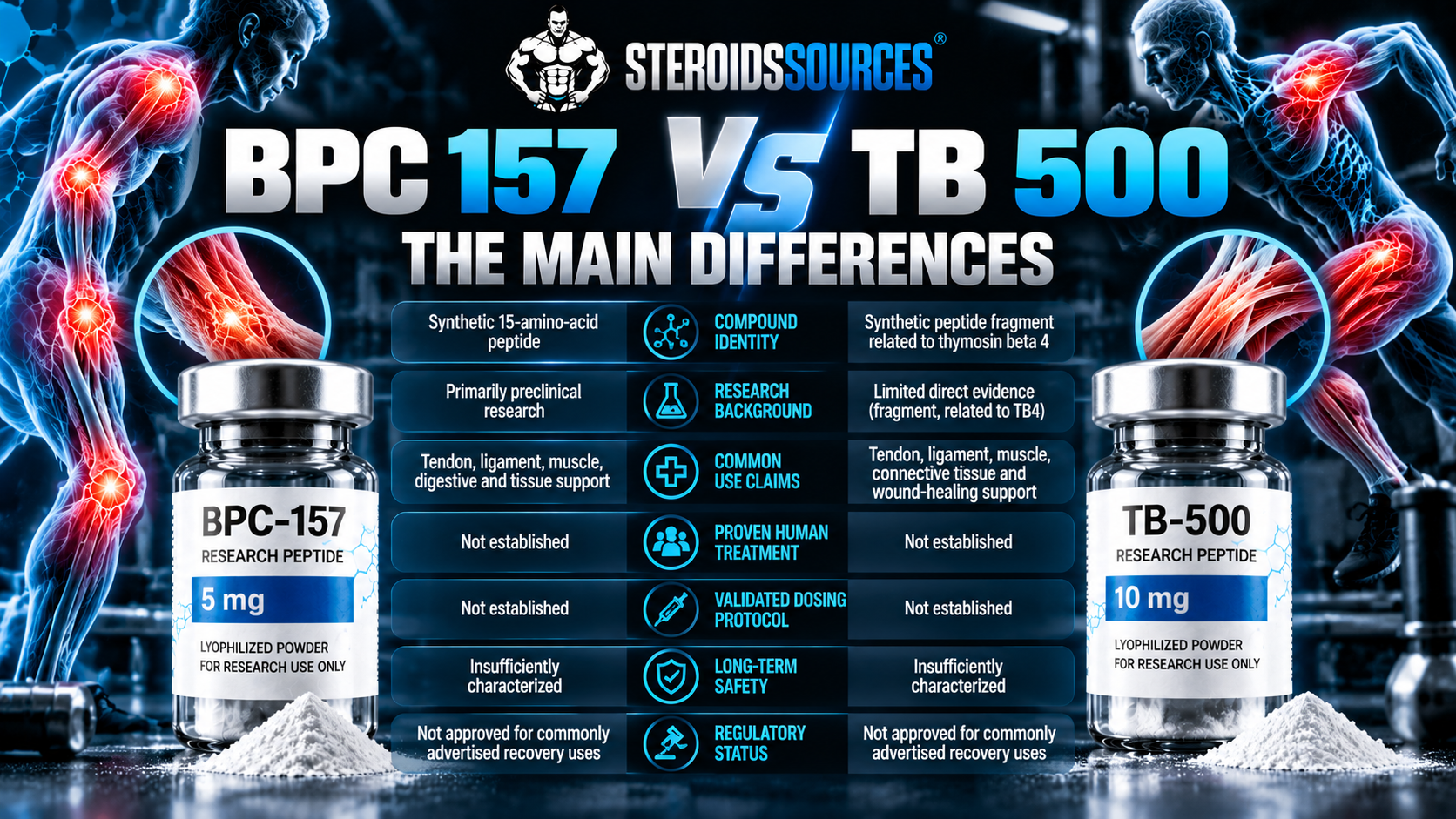
The most important conclusion is that neither compound has sufficient reliable human evidence to establish it as a proven solution for injury recovery.
It would be misleading to declare one the clear winner based only on animal studies, mechanistic explanations, seller descriptions, or personal testimonials.
BPC 157 vs TB 500 for Tendon Repair
The keyword bpc 157 vs tb 500 for tendon repair reflects one of the main reasons people compare these compounds.
Tendons connect muscles to bones and transmit force during movement. They can be affected by acute injuries, repetitive loading, or chronic tendon disorders. Recovery may involve changes in collagen structure, cellular activity, inflammation, and the gradual restoration of mechanical function.
Because tendon problems can take time to resolve, compounds promoted for tissue repair may appear attractive to people who want to return to training sooner.
The important question, however, is whether a peptide has been shown to improve tendon healing in humans—not whether a proposed mechanism sounds plausible.
BPC 157 and tendon research
BPC 157 has been investigated in preclinical models involving different tissues and injury-related processes. Some experimental findings have attracted interest in its possible effects on tendon-related healing.
Preclinical evidence has important limitations. Animal tendons are not identical to human tendons, and the experimental injuries and treatment conditions may not reflect common sports injuries.
Evidence from animal studies does not establish that BPC 157 restores human tendon strength, reduces re-injury risk, shortens rehabilitation, or improves long-term function.
TB 500 and tendon research
The proposed tendon-related effects of TB 500 are often discussed alongside biological research on thymosin beta 4. Researchers have examined the full-length protein in relation to cellular processes that may be relevant to tissue responses.
However, research on thymosin beta 4 cannot automatically prove that TB 500 has the same activity or clinical effects.
There is insufficient direct human evidence to conclude that TB 500 reliably repairs tendon injuries or improves tendon recovery outcomes.
Which is better for tendon repair?
Based on current evidence, neither BPC 157 nor TB 500 can be identified as a proven treatment for human tendon repair.
A responsible comparison must acknowledge that the research is incomplete and that different types of evidence cannot be treated as interchangeable. Claims that one peptide is definitively superior are not supported by adequate comparative human trials.
For a suspected tendon tear, persistent tendon pain, or loss of function, an appropriate diagnosis and rehabilitation plan are more reliable starting points than an unapproved research compound.
BPC 157 vs TB 500 for Muscle Recovery

Muscle recovery is another reason these peptides attract attention. Resistance training can produce temporary soreness and fatigue, while strains and tears may involve more substantial tissue damage.
Online discussions sometimes claim that BPC 157 or TB 500 can speed muscle repair, reduce downtime, or help athletes maintain demanding training schedules.
Those claims require careful interpretation.
What does the research establish?
Preclinical research into BPC 157 and research involving thymosin beta 4 may provide information about biological processes relevant to tissue responses. However, such findings do not prove that either compound improves human muscle recovery.
To establish a meaningful benefit, clinical trials would need to measure relevant outcomes, such as pain, strength, mobility, time to return to activity, or the rate of subsequent injury.
There is not enough reliable human evidence to conclude that either peptide consistently improves these outcomes.
Can either peptide improve training performance?
A compound marketed for recovery is not automatically a performance-enhancing treatment. Even if a substance affects a particular biological pathway, it does not necessarily improve strength, endurance, muscle growth, or training consistency.
The evidence does not establish BPC 157 or TB 500 as proven athletic performance enhancers.
Claims about faster recovery should therefore be treated as unverified unless supported by appropriate human studies involving the exact compound.
BPC 157 vs TB 500 for Armwrestling
The keyword bpc 157 vs tb 500 armwrestling targets a specific audience: people involved in a sport that places substantial demands on the wrist, elbow, forearm, and surrounding connective tissues.
Armwrestling involves high forces and complex joint positions. Athletes may experience overuse symptoms, muscle strains, tendon irritation, or more serious injuries. The combination of force, leverage, and fatigue can place considerable stress on the arm.
This context helps explain why recovery peptides are discussed in armwrestling communities, but it does not establish that either compound is effective for the sport’s common injuries.
Why armwrestlers search for these peptides
Athletes may look for ways to manage recurring elbow discomfort, forearm strain, or tendon-related symptoms while continuing to train. Online discussions often assign BPC 157 a general tissue-repair role and associate TB 500 with broader muscle or connective tissue recovery.
These descriptions are simplified marketing narratives rather than established comparative medical findings.
There is no reliable evidence demonstrating that BPC 157 is the better choice for armwrestling injuries, that TB 500 is superior for elbow or forearm recovery, or that combining them improves competitive performance.
What matters more for armwrestling recovery?
A useful recovery strategy begins with understanding the injury. Elbow or forearm pain may have several causes, and the appropriate approach depends on the affected tissue and the severity of the problem.
Appropriate training modification, rehabilitation, adequate recovery, and qualified medical assessment can help address the underlying issue. Severe pain, deformity, sudden loss of strength, or an acute injury requires prompt medical evaluation.
Athletes should also consider the rules of their governing organization. A compound’s online availability does not establish that it is permitted in competition.
TB 500 vs BPC 157 Dosage: Is There a Proven Protocol?
Searches for tb 500 vs bpc 157 dosage are common because readers want to know whether the compounds have established dosing protocols.
The key limitation is that neither peptide has a validated human dosing protocol for the commonly advertised injury-recovery uses.
A responsible comparison cannot provide a clinically established dose when suitable evidence is lacking. Dosage information posted on a seller’s website, discussion forum, or social media account is not equivalent to a protocol validated in clinical trials.
Why dosing cannot be determined from online claims
A scientifically supported dosing protocol normally depends on evidence about the exact substance, its formulation, its behavior in the body, the condition being treated, and its safety profile.
Researchers also need to understand how exposure relates to both benefits and adverse effects. Without adequate studies, it is not possible to reliably establish an appropriate dose, frequency, treatment duration, or monitoring plan for these compounds.
This is particularly important when a product’s identity or quality has not been independently established.
Does the amount in a vial establish the dose?
No. A label stating a particular quantity describes the amount claimed to be present in the container. It does not establish that the amount is appropriate for administration, that the product is suitable for human use, or that the compound is safe and effective.
The distinction between the amount in a container and a medically validated dose is important for any research chemical product.
What about dosing for a specific injury?
The phrase bpc 157 and tb 500 dosage for injury assumes that a validated treatment protocol exists for using these compounds to manage an injury. That has not been established by reliable human clinical evidence.
Different injuries also have different causes and treatment requirements. A tendon injury, a muscle tear, and a joint condition should not be assumed to respond in the same way to an experimental peptide.
For these reasons, online dosing schedules should not be treated as medical recommendations. A qualified healthcare professional can help assess an injury and discuss options supported by better evidence.
BPC 157 TB 500 Blend Dosage Per Week: What Should You Know?
The search phrase bpc 157 tb 500 blend dosage per week reflects interest in products or protocols that combine the two compounds.
Some online sellers and fitness discussions suggest that the peptides may complement each other because they are associated with different biological hypotheses. However, the idea that two compounds might have complementary mechanisms does not demonstrate that combining them improves clinical outcomes.
Is a combined protocol established?
There is no established, evidence-based weekly dosing protocol for a BPC 157 and TB 500 blend for injury recovery.
Adequate research would need to examine the exact substances, the formulation, exposure, safety, and clinically meaningful outcomes. It would also need to determine whether the combination provides any additional benefit compared with each compound individually or with appropriate standard care.
Without such evidence, claims about an optimal weekly amount or a superior combination remain unverified.
Does combining two peptides improve results?
Not necessarily. Combining experimental compounds can introduce additional uncertainty. If an adverse effect occurs, it may be difficult to identify which substance contributed to it. Potential interactions, combined effects, and long-term risks may also be insufficiently characterized.
Product quality is another concern. A blend’s label does not independently verify the identity, concentration, purity, or stability of each ingredient.
The most evidence-based conclusion is that the effectiveness and safety of a BPC 157 and TB 500 blend for human injury recovery have not been established.
Are BPC 157 and TB 500 Better Together?
Some online claims describe the two peptides as complementary, with BPC 157 associated with localized tissue recovery and TB 500 associated with broader cellular or connective tissue processes.
These descriptions can sound convincing, but they should not be interpreted as proof that the compounds work better together.
A combination needs to be studied directly. Evidence about one compound cannot establish the effectiveness of another, and research involving related proteins cannot automatically validate a blend containing a synthetic fragment.
There is insufficient high-quality human evidence to conclude that combining BPC 157 and TB 500 produces better tendon healing, faster muscle recovery, fewer injuries, or improved athletic performance than established rehabilitation approaches.
Readers should be cautious of claims that a blend is inherently more powerful or more complete simply because it contains two ingredients.
BPC 157 vs TB 500: Side Effects and Safety
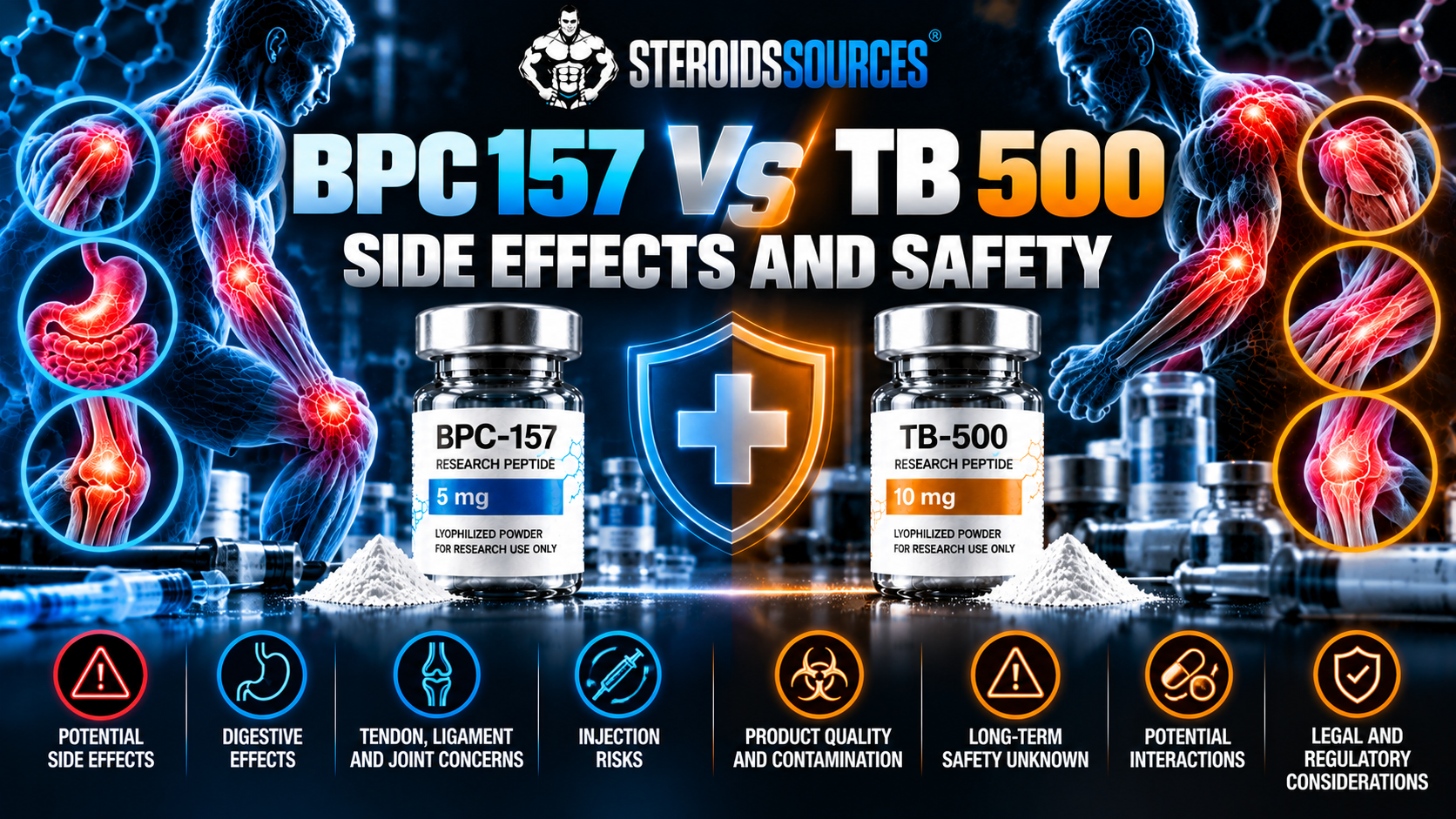
Safety is a central issue in any comparison of experimental peptides. Because reliable human data are limited, the full adverse-effect profiles of BPC 157 and TB 500 are not adequately characterized.
This means that users cannot confidently estimate the likelihood of side effects, determine long-term risks, or assume that a product is safe because other people report using it without obvious problems.
Unknown adverse effects
When a compound has not been adequately studied in humans, important adverse effects may remain undetected. The absence of well-documented problems does not prove that a substance is harmless.
Potential risks may depend on the exact compound, its purity, formulation, exposure, route of administration, and an individual’s health circumstances.
Product quality and contamination
Products sold online as research peptides may not always match their labels. Possible concerns include misidentification, incorrect concentration, impurities, degradation, or contamination.
A product photograph, label, seller statement, or certificate does not by itself establish that a product is safe for human administration. Even an analytical test that verifies certain aspects of identity or purity does not establish clinical safety or effectiveness.
Injectable product concerns
Some products marketed as these peptides are sold in forms intended for injection. Injectable products introduce concerns about sterility, contamination, and preparation in addition to uncertainty about the active substance.
A contaminated or incorrectly prepared product can create risks unrelated to the proposed biological activity of the peptide itself.
Long-term safety and interactions
There is insufficient evidence to establish the long-term safety of either compound for the commonly advertised uses. Potential interactions with medicines, supplements, other research compounds, or underlying medical conditions may also be poorly understood.
Combining BPC 157 and TB 500 does not remove these uncertainties. It may make it more difficult to determine which compound is responsible for an effect or adverse reaction.
Is either peptide risk-free?
No responsible evidence-based assessment can describe either compound as risk-free. Their limited human evidence means that benefits and risks cannot be confidently quantified for self-directed use.
Anyone considering an unapproved compound should discuss the issue with a qualified healthcare professional, particularly when managing an existing injury or medical condition.
Legal and Regulatory Considerations
BPC 157 and TB 500 should not be assumed to be approved medicines for injury recovery, tendon repair, or athletic performance enhancement.
Regulatory requirements vary by country and may depend on the exact product, its intended use, how it is supplied, and whether it is marketed as a medicine or research chemical. A product’s presence on an online marketplace does not establish regulatory approval.
It is also important to distinguish approval of a related molecule from approval of the exact compound being sold. Research on full-length thymosin beta 4, for example, does not automatically establish approval or safety for TB 500.
Athletes should separately check the applicable rules of their sporting organization. Regulatory status and competition eligibility are different questions, and neither can be inferred from marketing claims.
How to Evaluate Claims About BPC 157 vs TB 500
When comparing these peptides, readers can use several questions to assess whether a claim is supported by meaningful evidence.
Does the evidence involve the exact compound?
A study of BPC 157 does not establish the effects of TB 500. Similarly, research on full-length thymosin beta 4 cannot automatically be applied to the shorter TB 500 fragment.
The molecular identity of the studied substance matters.
Was the research conducted in humans?
Laboratory and animal studies can be valuable early research, but they cannot independently establish human effectiveness. Human clinical studies are needed to determine whether the compound produces meaningful benefits and what risks may occur.
Were clinically meaningful outcomes measured?
A change in a laboratory marker does not necessarily translate into less pain, stronger tendons, improved function, or a faster return to sport.
The strongest evidence would measure outcomes relevant to the condition being treated.
Are claims based on testimonials?
Personal experiences may be sincere, but they cannot reliably prove that a peptide caused an improvement. Injuries can change naturally, rehabilitation may contribute to recovery, and online reports may not represent people who experienced no benefit or adverse effects.
Does the seller make guaranteed claims?
Claims that a peptide heals every injury, has no side effects, or guarantees faster recovery should be treated with skepticism. Such statements go beyond what the available human evidence can establish.
So, Which Is Better: BPC 157 or TB 500?
The answer depends on what is meant by “better,” but the available evidence does not establish either compound as a superior treatment for human injury recovery.
BPC 157 has attracted preclinical interest in several tissue-related areas. TB 500 is associated with research discussions involving thymosin beta 4 and cellular processes. These different research backgrounds do not establish that one works better than the other.
For tendon repair, muscle recovery, armwrestling injuries, or general rehabilitation, there is not enough reliable direct human evidence to recommend one peptide over the other as a proven treatment.
The same limitation applies to dosage comparisons and combined protocols. Neither a particular dose nor a weekly blend schedule can be considered clinically validated based on online claims.
For people dealing with an injury, an accurate diagnosis, suitable rehabilitation, appropriate training modification, and qualified medical guidance offer a more reliable basis for decision-making than unapproved peptides with uncertain effects.
Frequently Asked Questions
What is the main difference between BPC 157 and TB 500?
BPC 157 is a synthetic 15-amino-acid peptide studied mainly in preclinical research. TB 500 is a name associated with a synthetic peptide fragment related to thymosin beta 4. They are different compounds, and evidence about one cannot automatically establish the effects of the other.
Is BPC 157 better than TB 500?
There is insufficient reliable human evidence to conclude that BPC 157 is better than TB 500 for injury recovery, tendon repair, or muscle recovery. Claims of superiority should be supported by direct comparative clinical trials, which are lacking.
Is TB 500 better than BPC 157 for tendon repair?
There is not enough direct human evidence to establish TB 500 as superior to BPC 157 for tendon repair. Research on related proteins or animal models cannot establish that either compound reliably heals human tendon injuries.
What does BPC 157 vs TB 500 dosage mean?
The phrase usually refers to comparing dosing schedules discussed online. However, neither compound has a validated human dosing protocol for the commonly advertised injury-recovery uses. Online schedules should not be treated as established medical recommendations.
Is there a proven BPC 157 TB 500 blend dosage per week?
No evidence-based weekly dosing protocol for a combined BPC 157 and TB 500 blend has been established for human injury recovery. The effectiveness, interactions, and safety of the combination remain uncertain.
Can BPC 157 and TB 500 be used for injury recovery?
Both are marketed for recovery-related purposes, but their effectiveness and safety for treating human injuries have not been adequately established. Injury management should be based on an appropriate diagnosis and evidence-supported care.
Which is better for armwrestling injuries?
There is no reliable evidence establishing BPC 157 or TB 500 as the better option for armwrestling injuries. The appropriate approach depends on the specific injury, its severity, and the rehabilitation required.
Are BPC 157 and TB 500 safe to combine?
The safety of combining these compounds has not been adequately established. Potential interactions, product quality, and the difficulty of attributing adverse effects to individual ingredients are important concerns.
Are BPC 157 and TB 500 approved for human use?
They should not be assumed to be approved medicines for the recovery and injury-related uses commonly promoted online. Regulatory requirements vary by jurisdiction and product, so readers should check the relevant local rules.
Can these peptides guarantee faster recovery?
No. Neither compound has sufficient reliable human evidence to guarantee faster healing or a successful return to sport. Recovery depends on the injury, appropriate care, rehabilitation, and other individual factors.
Final Verdict: BPC 157 vs TB 500
BPC 157 vs TB 500 is a popular comparison because both compounds are promoted online for tendon recovery, muscle repair, connective tissue support, and injury rehabilitation. However, their shared marketing claims do not mean they are interchangeable or that either has been established as an effective human treatment.
BPC 157 is primarily supported by preclinical research, while much of the discussion surrounding TB 500 draws on its relationship to thymosin beta 4. Neither evidence base is sufficient to establish reliable benefits for common human injury-recovery uses.
There is also no validated human dosage protocol for either peptide or for a blend containing both. Product quality, uncertain long-term effects, incomplete safety data, and regulatory considerations remain important concerns.
The most defensible conclusion is that neither compound can currently be identified as the clear winner for tendon repair, muscle recovery, or armwrestling injuries. Readers should separate scientific findings from seller claims and avoid treating unproven dosing schedules or testimonials as clinical evidence.