


Aromasin vs Arimidex

What Is the Difference?
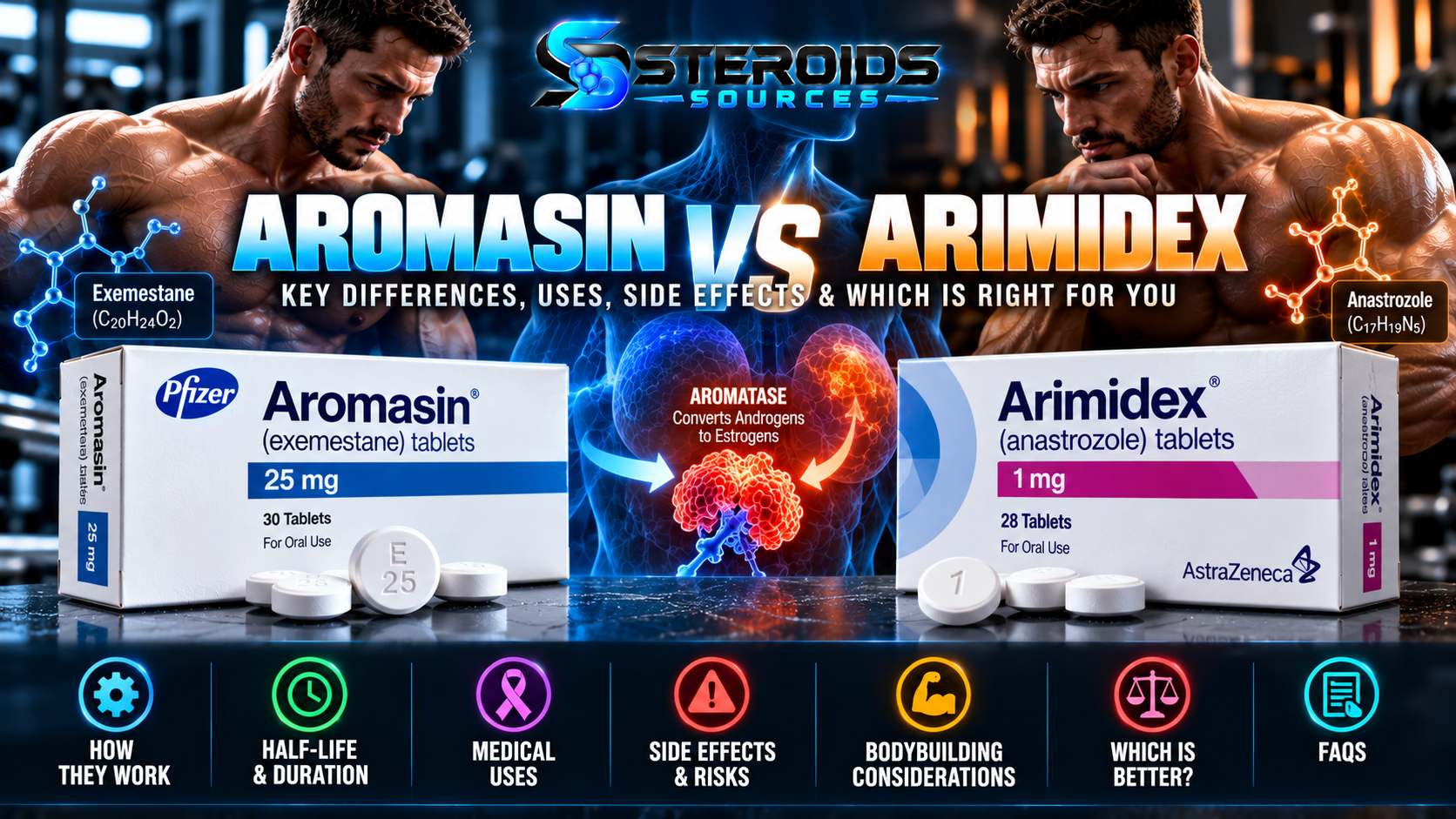
Aromasin vs Arimidex is a common comparison among people researching estrogen management, hormone-sensitive breast cancer treatment, and the effects of aromatase inhibitors. Although both medicines reduce estrogen production, they contain different active ingredients and work through different mechanisms.
Aromasin contains exemestane, a steroidal aromatase inactivator. Arimidex contains anastrozole, a nonsteroidal aromatase inhibitor. Both medications are used in specific breast cancer treatment settings, particularly when reducing estrogen is an important part of treatment.
They are also discussed in bodybuilding communities because anabolic-androgenic steroids can affect estrogen levels. However, medical use and bodybuilding use are not interchangeable. Neither medicine is approved as a bodybuilding drug, and unnecessarily reducing estrogen can cause significant health problems.
This guide compares Aromasin and Arimidex across seven important areas: drug classification, mechanism of action, half-life, approved uses, side effects, bodybuilding claims, and how clinicians approach treatment selection.
Quick Comparison: Aromasin vs Arimidex
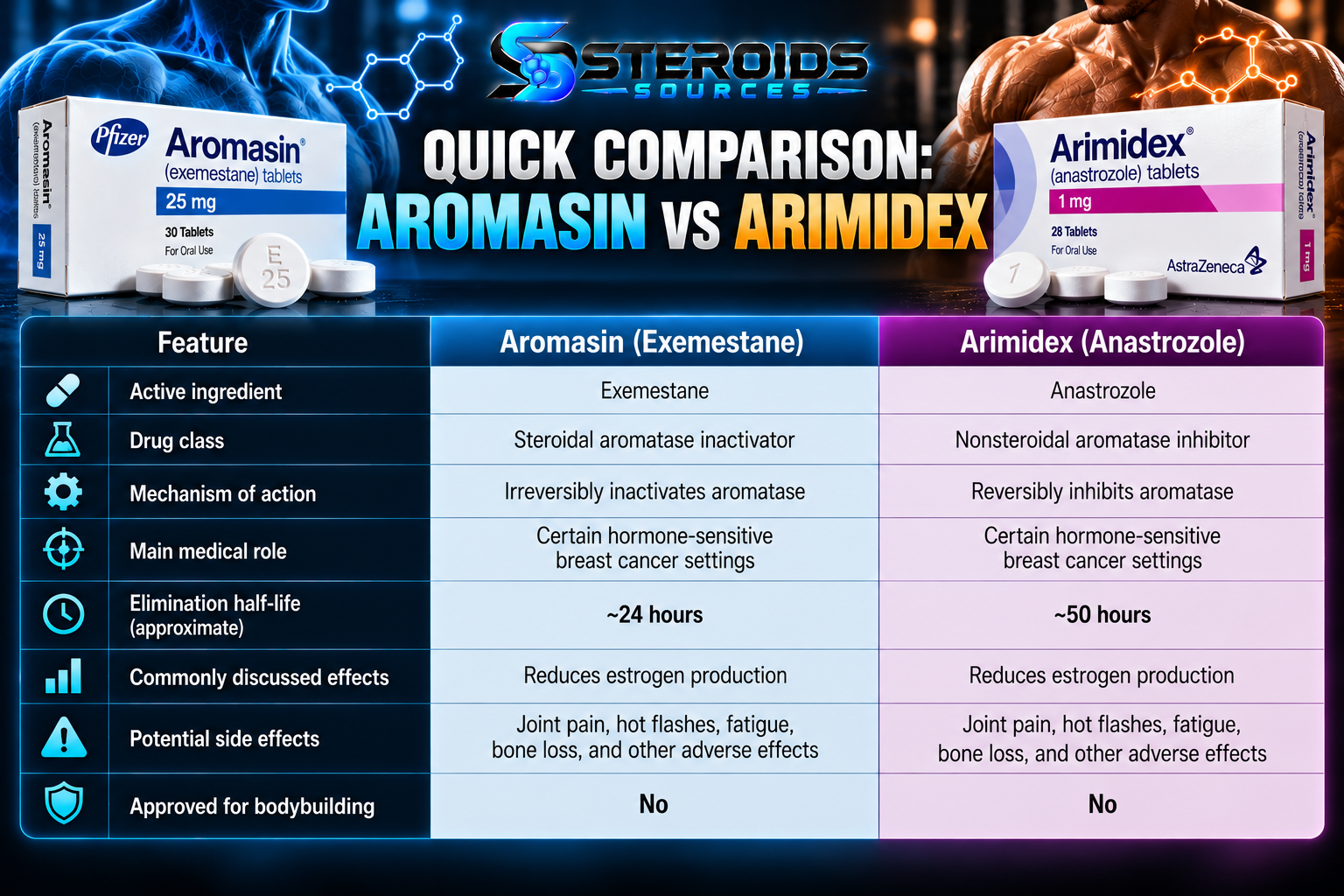
Half-life figures are approximate and can vary with the source and individual circumstances. They do not, by themselves, establish which medicine is more effective or safer.
1. What Are Aromasin and Arimidex?
Aromasin and Arimidex are prescription medicines known as aromatase inhibitors or, more precisely, aromatase-targeting drugs. They reduce the body’s production of estrogen by interfering with aromatase, an enzyme that converts certain androgens into estrogens.
Estrogen is important in everyone, including men. It contributes to bone health, sexual function, and other physiological processes. In some breast cancers, estrogen can stimulate cancer-cell growth, making estrogen reduction an important part of treatment.
What is Aromasin?
Aromasin is the brand name for exemestane. It is a steroidal aromatase inactivator that binds to aromatase and irreversibly inactivates the enzyme molecules it acts on.
Exemestane is used in specific treatment settings for postmenopausal women with hormone-receptor-positive breast cancer. Its role depends on the cancer’s characteristics and the patient’s previous treatment.
Because exemestane is steroidal, its chemical structure differs from that of nonsteroidal aromatase inhibitors. That structural distinction helps explain its mechanism, but it does not automatically make it more effective or safer.
What is Arimidex?
Arimidex is the brand name for anastrozole. It is a nonsteroidal aromatase inhibitor that reversibly binds to aromatase and inhibits its activity.
Anastrozole is also used in specific hormone-sensitive breast cancer treatment settings. Its prescribing information includes treatment of postmenopausal women with hormone-receptor-positive breast cancer, with the precise indication depending on the disease setting and treatment history.
Are they the same drug?
No. Aromasin and Arimidex have different active ingredients, chemical structures, and mechanisms of action. They share a therapeutic target—aromatase—but they should not be treated as interchangeable medicines without a clinician’s assessment.
Key takeaway: Aromasin contains exemestane, while Arimidex contains anastrozole. Both reduce estrogen production, but they do so differently.
2. Aromasin vs Arimidex: How Do They Work?
To understand the difference between Aromasin and Arimidex, it helps to understand aromatase.
Aromatase is an enzyme that converts androgens, including testosterone and androstenedione, into estrogens. By inhibiting this enzyme, aromatase inhibitors reduce estrogen production in tissues where the enzyme is active.
The two medicines affect aromatase differently.
How Aromasin works
Exemestane is described as an irreversible aromatase inactivator. It binds to aromatase and inactivates the enzyme. The effect on the enzyme molecule lasts beyond the period when free exemestane remains in the bloodstream, although the body can produce new enzyme.
This distinction is sometimes described as “suicidal inhibition” in pharmacology. It refers to the enzyme being inactivated during the interaction; it does not mean that Aromasin permanently eliminates aromatase activity throughout the body.
How Arimidex works
Anastrozole is a reversible aromatase inhibitor. It binds to aromatase and reduces its activity while the drug is interacting with the enzyme. As drug concentrations fall, inhibition can change accordingly.
This is a different biochemical mechanism from exemestane’s irreversible inactivation of individual enzyme molecules.
Does irreversible inhibition mean Aromasin is stronger?
Not necessarily. The words irreversible and reversible describe how the drugs interact with aromatase; they do not establish an overall ranking of clinical effectiveness.
The extent of estrogen suppression depends on several factors, including the medicine, exposure, treatment setting, and individual biology. Greater estrogen suppression is not automatically a better outcome. Excessively low estrogen can contribute to joint symptoms, sexual problems, and bone loss.
For patients receiving breast cancer treatment, the relevant question is which therapy is appropriate for the specific diagnosis and treatment plan—not which drug sounds stronger based on its mechanism.
For men considering these medicines because of hormone changes, symptoms alone cannot establish that estrogen is too high. Clinical assessment and appropriately interpreted laboratory results are important.
Aromasin vs Arimidex: Half-Life and Duration of Action
Half-life is one of the most frequently searched differences between Aromasin and Arimidex. It describes how long it takes for the concentration of a drug in the bloodstream to decrease by approximately 50% during its elimination phase.
The half-life is useful for understanding a medicine’s pharmacokinetics, but it does not tell the whole story about its biological effects.
Aromasin half-life
Exemestane has a mean terminal elimination half-life of approximately 24 hours. After the medicine is absorbed, its concentration decreases as the body metabolizes and eliminates it.
However, exemestane irreversibly inactivates the aromatase enzyme molecules it binds to. The duration of its effect therefore cannot be determined from blood concentration alone.
Arimidex half-life
Anastrozole has a mean elimination half-life of approximately 50 hours. This is longer than exemestane’s reported half-life, meaning anastrozole generally takes longer to be eliminated from the bloodstream.
Anastrozole reversibly inhibits aromatase, so its pharmacological activity is related to drug exposure and enzyme inhibition.
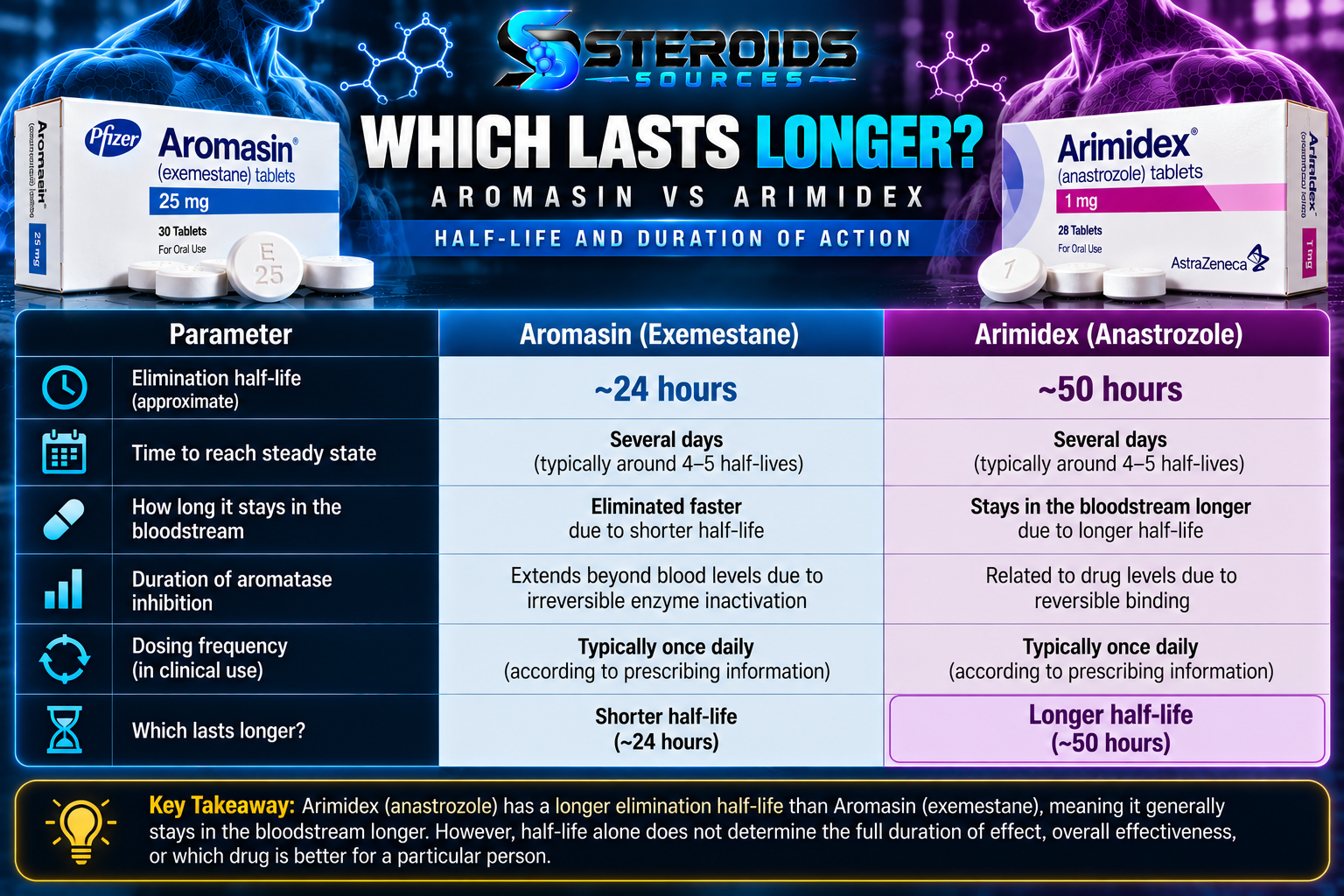
Which lasts longer?
Based on elimination half-life, Arimidex lasts longer in the bloodstream than Aromasin. That does not automatically mean it provides better estrogen control, causes fewer side effects, or is the better choice for a particular person.
.
It is also important not to use half-life calculations to decide when to start, stop, or switch prescription medication. Individual drug exposure, treatment goals, and clinical circumstances matter.
4. Aromasin vs Arimidex: Approved Medical Uses
Aromasin and Arimidex are used in hormone-sensitive breast cancer treatment, but their approved indications are not identical.
Estrogen can stimulate the growth of some breast cancers. In postmenopausal women, much of the body’s estrogen is produced through aromatase activity in tissues outside the ovaries. Aromatase inhibitors reduce this source of estrogen and can help treat cancers that depend on it.
Approved uses of Aromasin
In the United States, Aromasin is indicated for:
- Adjuvant treatment of postmenopausal women with estrogen-receptor-positive early breast cancer after two to three years of tamoxifen, as part of a planned course of adjuvant hormonal therapy.
- Treatment of advanced breast cancer in postmenopausal women whose disease has progressed following tamoxifen therapy.
The specific treatment decision depends on the cancer diagnosis, previous therapy, and current clinical guidance.
Approved uses of Arimidex
In the United States, Arimidex is indicated for certain breast cancer treatment settings in postmenopausal women, including:
- Adjuvant treatment of hormone-receptor-positive early breast cancer.
- First-line treatment of locally advanced or metastatic breast cancer that is hormone-receptor-positive or has an unknown hormone-receptor status.
- Treatment of advanced breast cancer that has progressed following tamoxifen therapy.
Exact indications should be checked against the current prescribing information for the relevant country, since regulatory labeling can vary.
Are Aromasin and Arimidex interchangeable for breast cancer?
Not automatically. Both target estrogen production, but they have distinct clinical evidence, prescribing information, and treatment roles. A clinician chooses treatment based on factors such as the cancer’s receptor status, stage, previous therapies, menopausal status, side effects, and the overall treatment plan.
Patients should not change or discontinue cancer treatment because one drug appears more attractive in an online comparison.
5. Aromasin vs Arimidex: Side Effects and Long-Term Risks
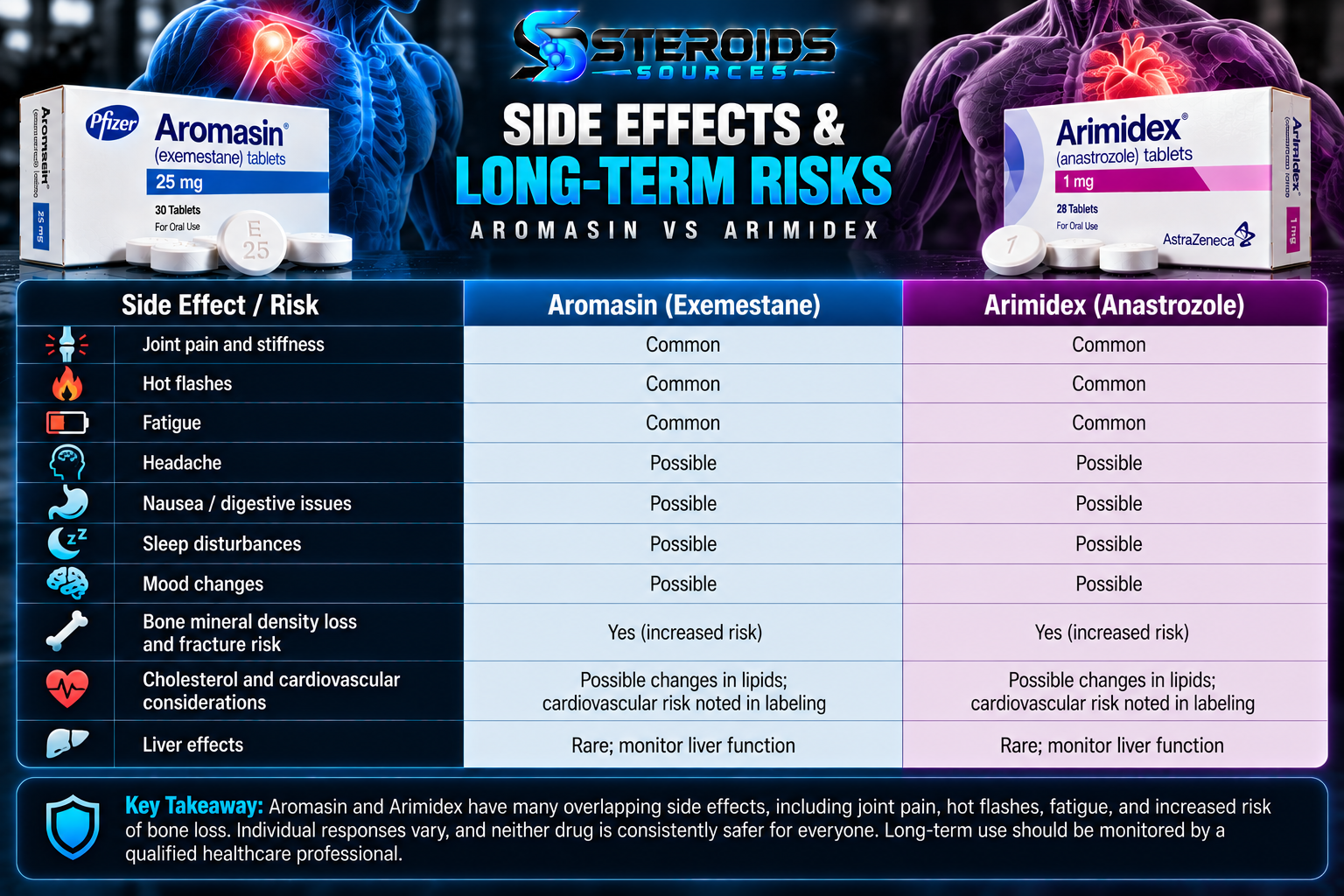
Both medicines lower estrogen, and many of their potential adverse effects overlap. The severity and likelihood of side effects vary among individuals and depend partly on treatment duration, baseline health, and other medicines.
Neither drug can be described as universally safer based on its class or mechanism alone.
Common side effects
Potential side effects of Aromasin and Arimidex include:
- Hot flashes
- Joint pain or stiffness
- Fatigue or weakness
- Headache
- Nausea
- Sleep difficulties
- Mood changes
The exact side-effect profile differs between clinical studies and patients. A symptom experienced by one person does not prove that the other medicine would be better tolerated.
Bone mineral density and fracture risk
Bone health is a major consideration with aromatase inhibitor treatment. Estrogen helps maintain bone density, so sustained estrogen reduction can contribute to bone loss and an increased risk of fractures.
This matters particularly for people who already have osteoporosis, previous fractures, or other risk factors for weakened bones. Clinicians may assess bone health and recommend monitoring or protective measures according to the patient’s circumstances.
Cholesterol and cardiovascular considerations
Changes in lipid measurements and cardiovascular risks are also relevant when evaluating aromatase inhibitors. The details differ between medicines, study populations, and treatment settings.
For example, prescribing information for anastrozole includes warnings and precautions relating to cholesterol and certain cardiovascular events. Exemestane’s prescribing information also discusses changes in bone mineral density and lipid-related findings.
These considerations do not mean that everyone taking either medicine will develop cardiovascular problems. They do mean that long-term treatment should be assessed in the context of the person’s overall health.
Can excessive estrogen suppression cause problems?
Yes. Estrogen has important physiological functions in men and women. Reducing it more than medically necessary may contribute to joint discomfort, sexual symptoms, bone loss, and other problems.
Aromatase inhibitors should not be used simply to achieve the lowest possible estrogen level. The appropriate goal depends on the medical indication and the patient’s clinical needs.
Seek medical advice if symptoms are persistent, severe, or worsening during treatment. Do not independently increase, reduce, or combine medicines to manage side effects.
6. Aromasin vs Arimidex for Bodybuilding
The comparison between Aromasin and Arimidex often appears in bodybuilding discussions because anabolic-androgenic steroids can increase estrogen production in some circumstances. Certain anabolic steroids can be converted into estrogens through aromatase, potentially affecting hormone levels and causing symptoms in susceptible individuals.
Aromasin and Arimidex are sometimes discussed as ways to reduce estrogen in these settings. However, the existence of a biochemical rationale does not establish that using either drug improves bodybuilding outcomes or is safe without medical supervision.
Why do bodybuilders discuss these drugs?
Online discussions commonly focus on concerns about estrogen-related symptoms, changes in body composition, and hormone levels during anabolic steroid use.
However, forum posts and personal anecdotes cannot reliably establish which drug works better. Reports may involve different compounds, doses, training practices, health conditions, and laboratory methods. They are also vulnerable to selection bias and incomplete reporting of adverse effects.
Neither Aromasin nor Arimidex is approved for bodybuilding, physique enhancement, or routine management of anabolic steroid cycles.
Aromasin vs Arimidex: Which is better for bodybuilding?
There is no reliable evidence establishing a universal winner for bodybuilding. The medicines have different mechanisms and half-lives, but these differences do not prove that one produces better muscle gains, better appearance, or fewer health risks.
Choosing an aromatase inhibitor based on online claims can be especially risky because estrogen symptoms are not always caused by elevated estrogen. Similar symptoms may have other causes, and hormone results need to be interpreted in context.
Can either medicine improve testosterone levels?
Aromatase inhibitors can alter the balance between androgens and estrogens. In some men, reducing conversion of testosterone to estradiol may increase measured testosterone levels. The response is variable, however, and cannot be assumed to improve strength, muscle growth, sexual function, or general health.
A higher testosterone result is not automatically a better health outcome. Estrogen also plays an important role in male physiology, including bone health and sexual function.
What are the risks of unsupervised use?
Potential concerns include excessive estrogen suppression, joint symptoms, reduced bone density, adverse changes in health markers, and interactions with other medicines. Products purchased from unverified sources can introduce additional uncertainty about authenticity and ingredient content.
For men experiencing breast tenderness, sexual symptoms, or suspected hormone imbalance, the safer approach is medical evaluation rather than self-prescribing an aromatase inhibitor. Treatment depends on the underlying cause and should not be based on a bodybuilding forum’s preferred drug.
7. Which Is Better: Aromasin or Arimidex?
There is no single answer that applies to everyone. The appropriate medicine depends on why treatment is needed, the evidence supporting each option for that condition, the person’s medical history, and how well the treatment is tolerated.
When treating breast cancer
The choice should be made by the treating oncology team. The diagnosis, receptor status, menopausal status, prior treatments, other medical conditions, and adverse effects all help determine the most appropriate therapy.
Patients should not switch between Aromasin and Arimidex without discussing the change with their prescriber.
When side effects are a concern
A person who develops joint pain, hot flashes, fatigue, or other symptoms may need an assessment to determine whether the medicine is responsible and what alternatives are appropriate. The answer is not necessarily to switch to the other aromatase inhibitor; other explanations and management options may need consideration.
When the goal is bodybuilding or hormone manipulation
Neither medicine is an approved bodybuilding drug, and evidence does not support declaring one the better choice for physique enhancement. Reducing estrogen unnecessarily can undermine health rather than improve performance.
If there is a genuine concern about hormone levels, a clinician can evaluate symptoms, relevant laboratory tests, medications, and other possible causes before deciding whether treatment is appropriate.
Final verdict
Aromasin and Arimidex both reduce estrogen production, but they are not identical. Aromasin (exemestane) is a steroidal, irreversible aromatase inactivator with an approximate 24-hour elimination half-life. Arimidex (anastrozole) is a nonsteroidal, reversible aromatase inhibitor with an approximate 50-hour half-life.
Those differences matter pharmacologically, but they do not establish that one is universally stronger, safer, or better. Their approved medical uses, side effects, and treatment evidence must be considered in context. For bodybuilding use, neither is approved for that purpose, and unsupervised estrogen suppression carries avoidable risks.
Frequently Asked Questions: Aromasin vs Arimidex
1. What is the main difference between Aromasin and Arimidex?
Aromasin contains exemestane, a steroidal, irreversible aromatase inactivator. Arimidex contains anastrozole, a nonsteroidal, reversible aromatase inhibitor.
2. How do Aromasin and Arimidex work?
Both inhibit aromatase, the enzyme responsible for converting certain androgens into estrogens, thereby reducing estrogen production.
3. Which has a longer half-life, Aromasin or Arimidex?
Arimidex has the longer elimination half-life: approximately 50 hours compared with about 24 hours for Aromasin.
4. What are the common side effects of Aromasin vs Arimidex?
Both may cause hot flashes, joint pain, fatigue, headache, and other adverse effects. Individual responses vary.
5. Can Aromasin and Arimidex affect bone density?
Yes. Lower estrogen levels can reduce bone mineral density and increase fracture risk, especially during prolonged treatment.
6. Is Aromasin or Arimidex better for bodybuilding?
Neither is established as universally better for bodybuilding, and neither is approved for physique enhancement.
7. Can Aromasin or Arimidex increase testosterone in men?
They may increase testosterone in some circumstances by reducing its conversion to estrogen, but the response varies and does not guarantee better performance.
8. Which is stronger at lowering estrogen, Aromasin or Arimidex?
There is no universal winner. Estrogen suppression depends on the medicine, exposure, individual response, and clinical context.
9. Are Aromasin and Arimidex approved for the same medical uses?
They have overlapping roles in certain hormone-sensitive breast cancer settings, but their approved indications are not identical.
10. Can you switch from Aromasin to Arimidex?
A clinician may recommend switching in some circumstances, but the decision should account for treatment goals, side effects, and medical history.
Important Medical Note
This article is for educational purposes and is not a substitute for individualized medical advice. Aromasin and Arimidex are prescription medicines. Do not start, stop, combine, or switch them without guidance from a qualified healthcare professional.