


Half-Life of Arimidex

Half-Life of Arimidex
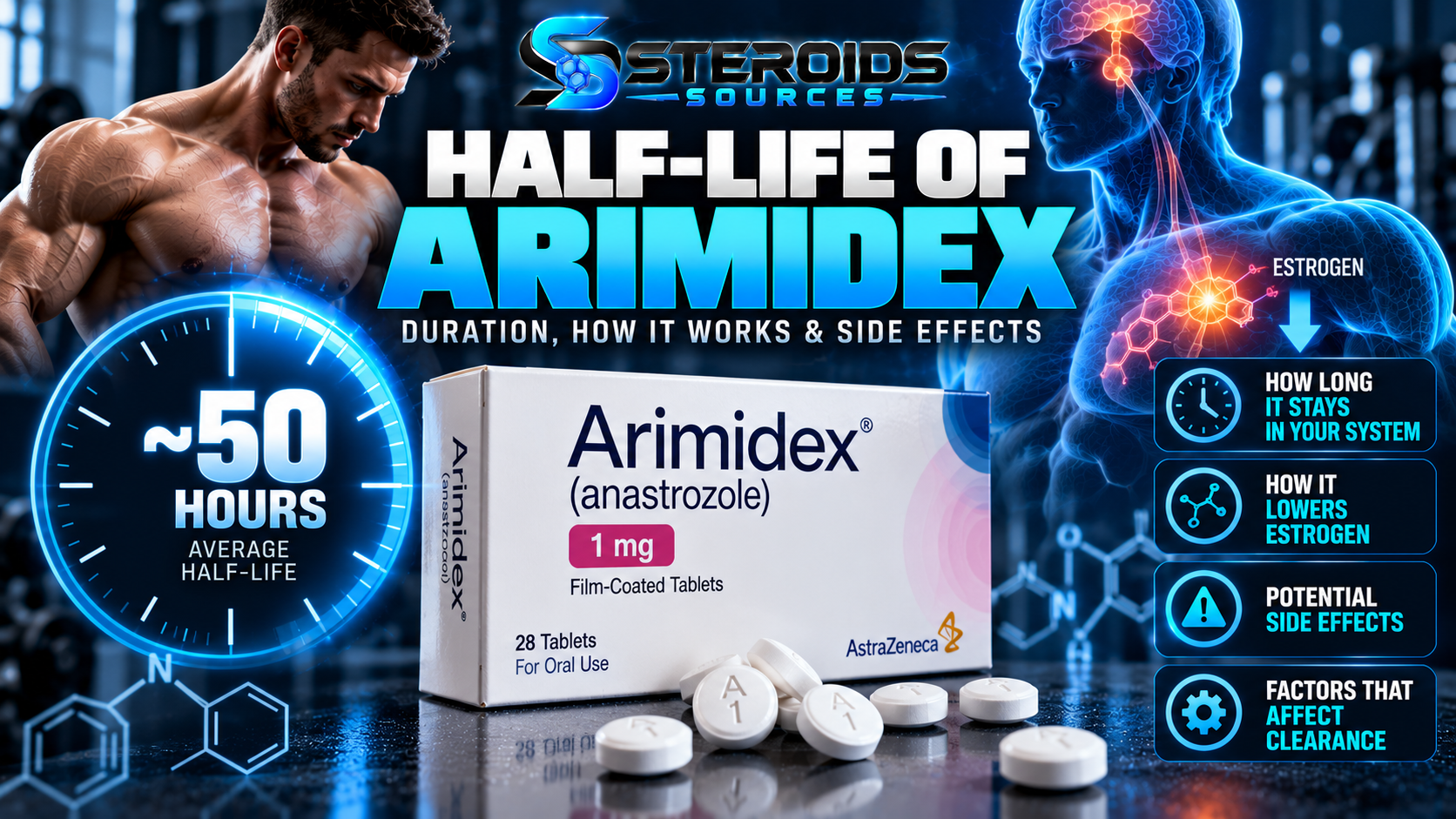
Half-life of Arimidex is an important topic for anyone trying to understand how long anastrozole remains in the body, how it reduces estrogen, and why its effects may continue after a dose has been absorbed. Arimidex is the brand name for anastrozole, a prescription aromatase inhibitor used primarily in the treatment of hormone receptor-positive breast cancer in appropriate patients.
Anastrozole has an average elimination half-life of approximately 50 hours. This means the amount of drug in the body decreases by about half over that period, on average. It does not mean the medication stops working after 50 hours, nor does it mean every trace disappears after two days.
Understanding the half-life of Arimidex requires looking at more than a single number. The drug’s absorption, metabolism, estrogen-suppressing action, individual differences, and potential adverse effects all matter. Its approved medical use also differs substantially from off-label use by some bodybuilders seeking to manage estrogen levels.
This guide explains the pharmacology in plain language, summarizes important safety considerations, and separates established medical information from claims that are not supported by strong clinical evidence.
1. What Is the Half-Life of Arimidex?
Arimidex (anastrozole) has an average terminal elimination half-life of approximately 50 hours. The terminal half-life describes how long it takes for the amount of drug in the body to decline by half during the elimination phase.
The concept is easier to understand with a simplified example. If the amount of a drug in the body were 100 units at the start of an elimination period, about 50 units would remain after one half-life, 25 after two half-lives, and 12.5 after three. These are illustrative amounts, not measurements of a particular person’s blood concentration.
What does a 50-hour half-life mean?
A half-life helps describe how quickly a medication is eliminated. It is not the same as the duration of every clinical effect, and it does not establish when someone will feel a change.
Anastrozole inhibits aromatase, an enzyme involved in converting androgens into estrogens. Its pharmacological effect depends on this enzyme inhibition as well as drug exposure. Consequently, estrogen levels and symptoms do not necessarily change in a simple, hour-by-hour pattern that mirrors the amount of anastrozole in circulation.
The practical points are:
- Half-life: Anastrozole’s average elimination half-life is about 50 hours.
- Duration of effect: Estrogen suppression does not necessarily end when one half-life has passed.
- Individual variation: Drug exposure and response can differ between people.
- Clinical decisions: Half-life alone is not enough to determine whether treatment should be started, changed, or stopped.
Does half-life mean the drug is gone after 50 hours?
No. After one half-life, approximately half the amount present at the start of the elimination phase remains. After another half-life, roughly half of that remaining amount is eliminated.
A simplified model illustrates the decline:
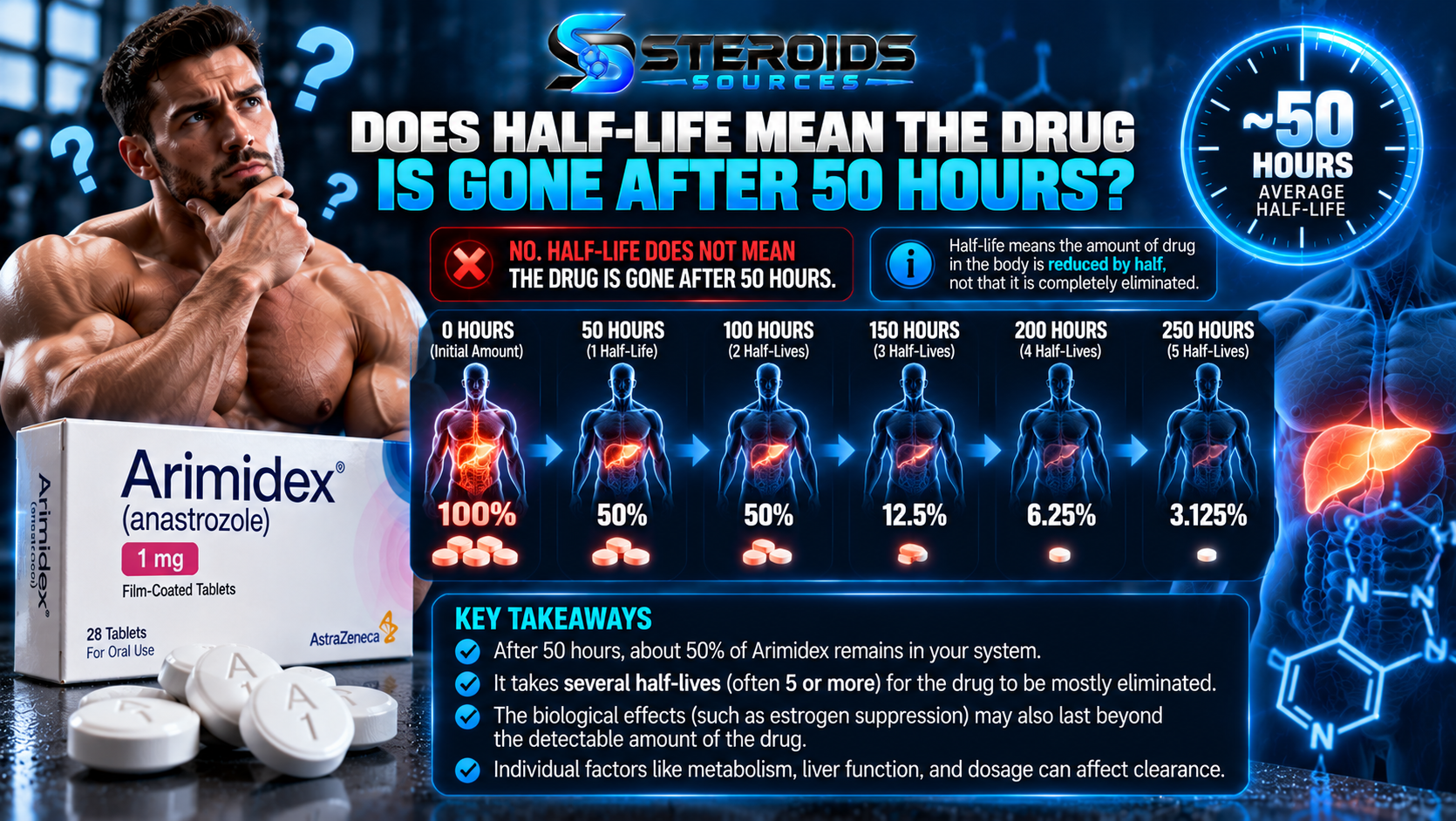
These percentages are simplified estimates based on repeated half-lives. They are not a personal prediction of blood concentration, estrogen levels, or the time at which the effects of Arimidex will stop.</em>
Even after most of a medication has been eliminated, the clinical response may take a different amount of time to resolve. Conversely, the presence of a small residual amount does not mean that every effect remains equally strong.
2. How Long Does Arimidex Stay in Your System?
Because the average half-life is around 50 hours, anastrozole declines gradually rather than disappearing from the body overnight. It can take several half-lives for the amount present to become small.
Using the simplified model above, about five half-lives correspond to approximately 10 days and leave around 3% of the initial amount. This is a pharmacokinetic approximation, not a guarantee that the medication is completely absent after that time.
Why there is no single exact clearance time
The phrase “out of your system” can mean several different things:
- The amount in the bloodstream has fallen substantially.
- The drug is no longer producing a clinically meaningful effect.
- Estrogen levels have changed following treatment.
- A laboratory test can no longer detect the compound.
- The person no longer experiences a side effect.
These are not interchangeable endpoints. A drug can fall to a low concentration while its biological effects continue, and the time required for symptoms or hormone levels to change may differ from the time required for elimination.
Individual factors, including liver function, age, other medications, and the clinical circumstances of treatment, may also affect exposure or response. The half-life figure is an average and should not be used as a precise countdown for a particular person.
Does Arimidex accumulate in the body?
With repeated administration, a medication may accumulate until the amount entering the body over time is balanced by the amount being eliminated. The extent and timing of accumulation depend on the drug’s pharmacokinetics and the treatment schedule.
Anastrozole’s relatively long half-life means that previous exposure can still contribute to the amount in the body when another dose is taken under a prescribed regimen. This is one reason that changes in exposure and clinical response should not be judged from a single day alone.
Accumulation is not automatically harmful; it is a normal pharmacokinetic consideration. Whether a medicine is appropriate depends on its indication, prescribed use, expected benefit, and potential risks.
Can you speed up Arimidex clearance?
There is no established home method that safely and reliably accelerates anastrozole elimination. Drinking excessive amounts of water, using “detox” products, or adding other medicines should not be assumed to clear the drug faster.
If Arimidex was prescribed, do not change or discontinue the treatment solely because of a half-life calculation. If you believe you have taken too much, are experiencing significant symptoms, or have questions about an unintended exposure, contact a qualified healthcare professional or local poison-information service for advice.
3. How Arimidex Works: The Link Between Half-Life and Estrogen
Anastrozole belongs to a class of medicines called aromatase inhibitors. Aromatase is an enzyme that converts certain androgens, including androstenedione and testosterone, into estrogens.
By inhibiting aromatase, anastrozole reduces estrogen production. This mechanism is useful in certain hormone-sensitive breast cancers, where estrogen can stimulate the growth of cancer cells.
What happens after anastrozole is absorbed?
After oral administration, anastrozole is absorbed and reaches systemic circulation. It then inhibits aromatase, reducing estrogen synthesis. The medication is metabolized and gradually eliminated, but its pharmacological action is not defined by elimination alone.
This distinction matters because people sometimes assume that a medication’s effect rises and falls in direct proportion to its blood concentration. In reality, the relationship between drug exposure, enzyme inhibition, hormone levels, and symptoms can be more complex.
Does Arimidex lower estrogen immediately?
Anastrozole can begin inhibiting aromatase after it is absorbed, but the timing of measurable hormonal changes and the timing of symptom improvement are not necessarily identical.
The result depends on the starting hormone levels, the biological system being studied, the treatment context, and the outcome being measured. In breast cancer care, response is assessed in the context of the prescribed treatment plan. It is not determined solely by whether someone notices an immediate sensation.
Why estrogen is not simply a “bad hormone”
Estrogen has important physiological functions in people of different sexes. In men, estrogen contributes to bone health, sexual function, and other aspects of normal physiology. In women, estrogen is involved in reproductive function, bone maintenance, and several other systems.
Excessive estrogen suppression can therefore create problems. The goal of an aromatase inhibitor in an approved medical setting is not to eliminate all estrogen; it is to achieve a therapeutic effect for a specific clinical indication while managing risks.
This is especially important when discussing bodybuilding. The assumption that lower estrogen is always better is not supported by physiology or clinical evidence. Symptoms alone also cannot reliably establish whether estrogen is high or low.
4. Arimidex Side Effects: What Should You Know?
Arimidex can cause adverse effects. The type and severity vary, and some symptoms may overlap with those caused by the underlying condition or other treatments.
In approved breast cancer treatment, clinicians consider these risks alongside the expected benefit. Off-label use for physique enhancement has a different benefit-risk context, particularly because the safety and effectiveness of self-directed estrogen suppression for bodybuilding goals have not been established in the same way as approved treatment.
Commonly reported side effects
Potential adverse effects associated with anastrozole include:
- Hot flashes
- Joint pain or stiffness
- Muscle or bone discomfort
- Fatigue or weakness
- Headache
- Nausea
- Mood changes
- Sleep disturbance in some individuals
Not everyone experiences these effects, and the list does not mean that a symptom is necessarily caused by anastrozole. Persistent, severe, or worsening symptoms deserve medical assessment rather than an assumption about their cause.
Joint pain and stiffness
Joint symptoms are a recognized concern with aromatase inhibitor treatment. They may interfere with everyday movement, exercise, or quality of life.
For a person using anastrozole as prescribed, new or persistent joint pain should be discussed with the treating clinician. It is not advisable to self-adjust treatment or add other medicines without considering the full clinical picture.
Bone health
Estrogen plays an important role in maintaining bone density. Because anastrozole lowers estrogen production, longer-term treatment can contribute to bone loss and increase fracture risk in some patients.
This is a significant consideration in medical treatment plans, where bone health may be assessed according to a person’s risk factors and clinical circumstances. A bodybuilding context does not remove this concern: reducing estrogen excessively can undermine a system that supports skeletal health.
Cholesterol and cardiovascular considerations
Changes in lipid measurements and broader cardiovascular considerations may be relevant during aromatase inhibitor treatment. The significance depends on the individual, the duration of exposure, underlying health, and the treatment context.
People should not assume that anastrozole is cardiovascularly neutral simply because it is not an anabolic steroid. Nor should a particular cardiovascular outcome be attributed to the drug without considering the available evidence and other contributing factors.
Mood, fatigue, and sexual symptoms
Changes in mood, energy, or sexual function may have many possible causes. Hormonal changes can be one factor, but symptoms alone do not establish a specific hormone level or prove that anastrozole is responsible.
If these symptoms appear after starting a prescribed treatment, discuss the timing and severity with a healthcare professional. For someone using the drug without medical supervision, the uncertainty is greater because there may be no reliable baseline assessment or monitoring plan.
When should you seek medical attention?
Seek urgent medical assessment for symptoms that may indicate a serious reaction or another acute condition, such as chest pain, difficulty breathing, sudden weakness, or signs of a severe allergic reaction. For less urgent but persistent problems, contact the prescribing clinician rather than waiting for the medication to clear on its own.
Do not treat every symptom as a predictable consequence of estrogen suppression. A proper assessment may be needed to determine whether the cause is the medicine, another treatment, the underlying condition, or an unrelated health problem.
5. What Affects Arimidex Clearance and Response?
The average half-life is useful, but it does not describe every person’s experience. Several factors can influence drug exposure, treatment response, or the interpretation of symptoms.
Liver function and metabolism
Anastrozole is metabolized in the body, with the liver playing an important role in its metabolism. Significant differences in liver function may affect how medicines are handled. The clinical implications depend on the degree of impairment and the relevant prescribing information.
Anyone with known liver disease should ensure that the prescribing clinician is aware of it. Do not assume that a standard half-life estimate applies precisely in every clinical circumstance.
Age and overall health
Age, body physiology, other illnesses, and overall health can influence treatment response and the risks associated with therapy. These factors do not necessarily change the half-life by a predictable amount in every individual, but they can matter when clinicians evaluate drug exposure and side effects.
Other medications
Prescription medicines, over-the-counter products, and supplements can affect treatment in different ways. Some may influence drug metabolism, while others can produce overlapping adverse effects or complicate interpretation of symptoms.
Provide a clinician or pharmacist with a complete list of medicines and supplements. Avoid adding another hormone-modifying compound to “balance” the effects of anastrozole without medical advice.
Treatment duration and repeated exposure
The experience of a person receiving a single exposure may differ from that of someone receiving ongoing treatment. Repeated administration can result in accumulation, while longer-term changes such as bone-health effects require consideration beyond the elimination of a single dose.
The half-life alone cannot predict the full risk of treatment over weeks, months, or years.
The starting hormone environment
Anastrozole’s effects occur within a wider endocrine system. Baseline hormone levels, the source of estrogen production, and the medical reason for treatment influence how the drug is used and how results are interpreted.
A symptom such as fatigue, low libido, or joint discomfort is not a reliable substitute for clinical assessment. Depending on the situation, a clinician may consider symptoms, history, examination, and appropriate laboratory tests together.
6. Arimidex in Breast Cancer Treatment vs. Bodybuilding
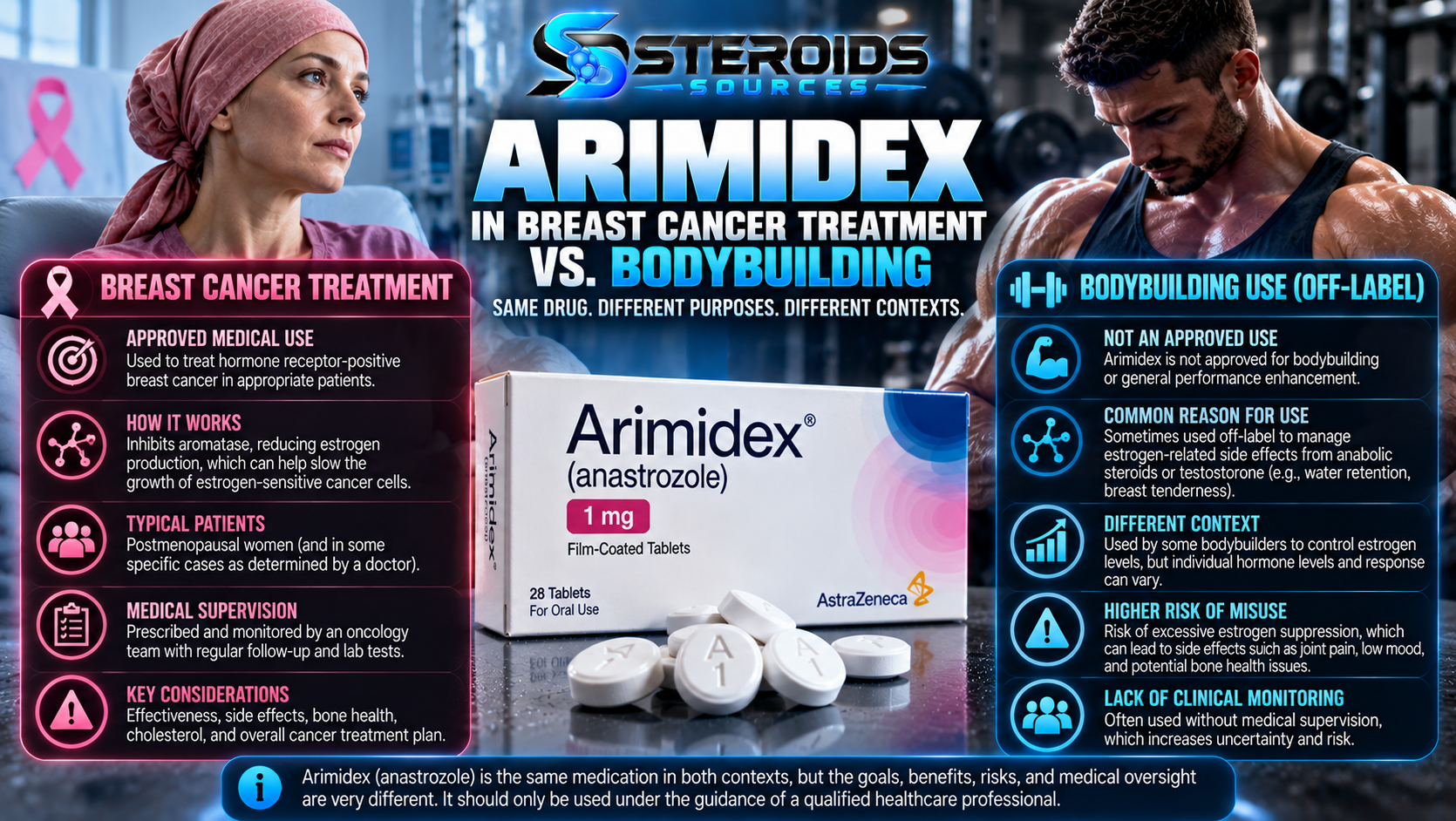
Arimidex is a prescription medication with established uses in the treatment of certain forms of hormone receptor-positive breast cancer. It should not be confused with an anabolic steroid, a general-purpose testosterone booster, or a supplement.
Some bodybuilders use anastrozole off-label in an attempt to manage estrogen associated with testosterone or other hormone-modifying substances. This is a different context from approved cancer treatment, and it is important not to treat information from one setting as proof of safety or effectiveness in another.
Approved medical use
In appropriate patients, anastrozole may be prescribed as part of breast cancer treatment. Decisions about its use depend on factors such as menopausal status, cancer characteristics, prior treatment, and the broader oncology plan.
In this setting, the potential benefit is evaluated against known risks, and treatment is managed by a qualified healthcare team. Monitoring and decisions about treatment duration are tied to the patient’s diagnosis and clinical needs.
Off-label bodybuilding use
Bodybuilding use often focuses on concerns such as water retention, breast tenderness, or perceived estrogen-related effects. These symptoms can have multiple causes, and they do not independently establish that estrogen is elevated.
Using anastrozole without a confirmed indication can lead to excessive estrogen suppression. Potential consequences include joint symptoms, effects on bone health, and other unwanted changes. It can also make it harder to determine which substance is causing a particular symptom when multiple compounds are being used.
Does Arimidex increase testosterone?
Anastrozole does not supply testosterone. By inhibiting aromatase, it reduces the conversion of androgens into estrogens. Changes in hormone measurements can occur, but the response depends on the person’s endocrine state and clinical context.
It is inaccurate to treat anastrozole as a universal testosterone booster. It is also unsafe to assume that a rise in a laboratory testosterone result automatically means a better health outcome.
Can bodybuilders use half-life to plan dosing?
A half-life number cannot establish a safe or effective self-directed dosing plan. It does not tell a person how much estrogen suppression is appropriate, whether treatment is indicated, or how their symptoms and laboratory results will respond.
For that reason, this article does not turn the half-life into a bodybuilding schedule. People prescribed anastrozole should follow their clinician’s instructions and discuss concerns before changing treatment.
7. Common Myths About the Half-Life of Arimidex
Myth 1: Arimidex is gone after two days
Fact: Approximately 50 hours is one average half-life, not the time required for complete elimination. A simplified model suggests that several half-lives are needed for the amount remaining to become small.
Myth 2: Estrogen returns to normal as soon as the drug concentration falls
Fact: Drug elimination, aromatase activity, estrogen levels, and symptoms are related but distinct. There is no universal timeline for every person.
Myth 3: A longer half-life means a stronger effect
Fact: Half-life describes elimination, not potency by itself. A drug’s clinical effect also depends on its mechanism, exposure, target interaction, and the condition being treated.
Myth 4: Lower estrogen always improves bodybuilding results
Fact: Estrogen has important physiological roles in men as well as women. Excessive suppression may be harmful, and there is no general rule that pushing estrogen as low as possible improves performance or health.
Myth 5: Symptoms can tell you exactly what your estrogen level is
Fact: Symptoms are nonspecific. Similar problems can arise from different hormone levels, other medicines, sleep disruption, training load, or unrelated medical conditions. Clinical assessment is more reliable than guessing from symptoms alone.
Myth 6: A half-life calculator can tell you when it is safe to stop treatment
Fact: A calculator can illustrate a theoretical decline in drug amount. It cannot determine whether stopping a prescribed medication is medically appropriate or predict the full course of symptoms and hormone changes.
Frequently Asked Questions About the Half-Life of Arimidex
What is the half-life of Arimidex?
The average elimination half-life of Arimidex (anastrozole) is approximately 50 hours. Individual drug exposure and response can vary.
How long does Arimidex stay in your system?
Anastrozole declines over multiple half-lives. A simplified five-half-life calculation is around 10 days, leaving a small fraction of the initial amount, but this is not a guarantee of complete elimination or the end of its biological effects.
Does Arimidex work for 50 hours?
The 50-hour figure describes average elimination half-life, not a fixed duration of clinical action. Aromatase inhibition and changes in estrogen levels do not necessarily stop at the end of one half-life.
How long does Arimidex take to lower estrogen?
Anastrozole begins acting after absorption, but the timing and extent of measurable estrogen changes depend on the clinical context and individual physiology. A single universal timeline should not be assumed.
Can Arimidex side effects continue after stopping?
They can. Drug levels decline over time, and symptoms do not necessarily disappear as soon as the amount in the body becomes small. Persistent symptoms should be evaluated, particularly if they are severe or affect daily life.
Does Arimidex cause low estrogen?
Anastrozole reduces estrogen production by inhibiting aromatase. Excessive suppression is possible, but symptoms alone cannot confirm a low estrogen level.
Is Arimidex a steroid?
No. Anastrozole is an aromatase inhibitor, not an anabolic-androgenic steroid. Its primary action is to reduce estrogen synthesis rather than directly activate androgen receptors.
Is Arimidex approved for bodybuilding?
No. Arimidex is a prescription medicine used for specific medical indications, including certain hormone-sensitive breast cancers. Bodybuilding use is off-label and is not an established, approved treatment for physique enhancement.
Should I adjust my dose based on its half-life?
No. Half-life calculations do not establish the correct dose or determine whether anastrozole is appropriate. Follow the prescribing instructions and speak with a qualified healthcare professional before making treatment changes.
Can I use Arimidex to manage estrogen while taking testosterone?
Anastrozole may be used in specific clinical circumstances, but routine self-directed use alongside testosterone is not automatically appropriate. Symptoms, treatment goals, laboratory findings, and potential harms need to be evaluated by a qualified clinician.
Final Verdict: What the Half-Life of Arimidex Really Means
The half-life of Arimidex is approximately 50 hours, which means anastrozole is eliminated gradually. A simplified calculation suggests that around 10 days covers five half-lives, but that estimate should not be confused with guaranteed complete elimination or a precise timeline for the end of its effects.
Anastrozole lowers estrogen by inhibiting aromatase. Its effects and risks depend on the medical context, the individual, and the broader hormonal environment. Potential adverse effects include hot flashes, joint symptoms, fatigue, and concerns about bone health during longer-term treatment.
For SteroidsSources readers, the key distinction is between understanding pharmacology and using a half-life number to self-manage a prescription drug. Arimidex has established medical uses, but off-label bodybuilding use carries uncertainties and can result in excessive estrogen suppression. Half-life alone cannot tell someone whether treatment is needed, how to use it, or when to stop.
The most responsible approach is to understand the evidence, avoid treating symptoms as a substitute for assessment, and discuss treatment decisions with a qualified healthcare professional.